The Astonishing Intelligence of Cephalopods
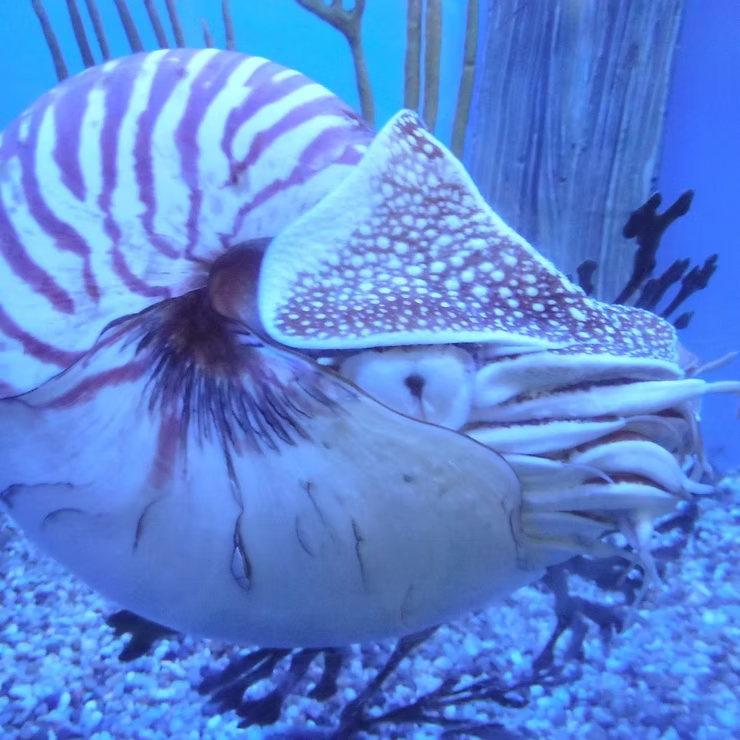
Cephalopods—particularly octopuses, cuttlefish, and squid—represent one of the most remarkable examples of cognitive evolution in the animal kingdom. These marine invertebrates possess sophisticated nervous systems, complex behaviors, and problem-solving abilities that rival those of many vertebrates. Their intelligence has evolved completely independently from the vertebrate lineage, offering a fascinating case study in alternative pathways to complex cognition. From tool use and camouflage to social learning and play behavior, cephalopods continue to surprise researchers with their cognitive capabilities, challenging our understanding of what constitutes intelligence in the animal kingdom.
Neurobiological Foundations of Cephalopod Intelligence
Cephalopods possess unique neurological architectures that support their complex behaviors.
Distributed Nervous System
Cephalopods have a radically different neural organization from vertebrates:
• Central brain: Contains approximately 40-50 million neurons in octopuses
• Peripheral nervous system: Two-thirds of neurons are distributed in the arms
• Neural autonomy: Arms can process sensory information and execute complex movements independently
• Vertical lobe: Specialized structure associated with learning and memory functions
Neural Plasticity and Adaptation
Cephalopod nervous systems show remarkable adaptability:
• RNA editing: Extensive recoding of neural proteins allows environmental adaptation
• Lifelong learning: Continuous neurogenesis in some species supports ongoing learning
• Environmental responsiveness: Neural development influenced by environmental complexity
• Behavioral flexibility: Rapid neural adaptations support diverse behavioral strategies
Sensory Processing Capabilities
Advanced sensory systems support complex cognition:
• Visual processing: Sophisticated eyes with exceptional spatial resolution
• Tactile sensing: Chemotactile receptors in suckers provide detailed environmental information
• Proprioception: Complex awareness of arm position and movement
• Integrated sensing: Multimodal information processing across distributed nervous system
Cognitive Capabilities and Problem-Solving
Cephalopods demonstrate a wide range of advanced cognitive abilities.
Tool Use and Object Manipulation
Remarkable examples of cephalopod tool use:
• Coconut carrying: Veined octopuses transport and use coconut shells as portable shelters
• Shell assembly: Some species assemble multiple shells to create protective structures
• Water jetting: Using directed water streams to manipulate objects or clean areas
• Problem-solving: Innovative approaches to accessing food in controlled experiments
Learning and Memory
Sophisticated learning capabilities across multiple domains:
• Spatial learning: Complex navigation in three-dimensional environments
• Associative learning: Forming connections between stimuli and rewards
• Observational learning: Acquiring information by watching conspecifics
• Long-term memory: Retaining information for extended periods despite short lifespans
Predatory Strategies and Foraging Intelligence
Complex hunting behaviors demonstrating advanced cognition:
• Selective targeting: Choosing prey based on nutritional value and capture difficulty
• Sequential planning: Executing multi-step hunting strategies
• Adaptive techniques: Modifying hunting methods based on prey behavior
• Risk assessment: Balancing predation opportunities with safety considerations
Camouflage and Communication
Cephalopods possess extraordinary abilities in visual communication and disguise.
Dynamic Camouflage System
The most sophisticated camouflage system in the animal kingdom:
• Chromatophores: Pigment-containing cells controlled with precision
• Iridophores: Light-reflecting cells creating structural colors
• Papillae: Muscular structures that change skin texture
• Neural control: Direct brain-to-skin connections enabling rapid changes
Complex Signaling Repertoire
Sophisticated communication through visual displays:
• Deimatic displays: Startling predators with sudden appearance changes
• Courtship signals: Complex patterns during mating interactions
• Aggressive displays: Warning signals to competitors or predators
• Metachrosis: Rapid color changes conveying different messages
Contextual Communication
Adaptive signaling based on social and environmental factors:
• Receiver-specific signals: Tailoring displays to particular individuals
• Environmental matching: Adjusting signals based on background conditions
• Deceptive signaling: Using camouflage for both hiding and false appearance
• Simultaneous signaling: Different messages to different receivers simultaneously
Social Behavior and Interaction
Despite their primarily solitary nature, cephalopods exhibit complex social behaviors.
Mating Systems and Reproductive Strategies
Complex reproductive behaviors demonstrating social intelligence:
• Mate choice: Selective mating based on multiple criteria
• Courtship rituals: Elaborate displays and interactions before mating
• Sperm competition: Complex mating strategies in some species
• Parental investment: Extended egg-guarding behaviors in many species
Aggregation and Group Dynamics
Social behaviors in normally solitary species:
• Seasonal aggregations: Temporary social groupings in some squid species
• Hierarchical structures: Dominance relationships in group situations
• Collective signaling: Coordinated displays in group contexts
• Social learning: Information transfer between individuals
Interspecific Interactions
Complex relationships with other species:
• Cleaning symbiosis: Allowing cleaner fish to remove parasites
• Protective relationships: Using other species as living shields
• Hunting partnerships: Coordinated hunting with fish species
• Defensive associations: Seeking protection from predators near other animals
Play Behavior and Curiosity
Cephalopods exhibit behaviors suggesting curiosity and playfulness.
Exploratory Behavior
Active investigation of novel objects and environments:
• Object manipulation: Extensive handling and examination of new items
• Environmental exploration: Systematic investigation of new habitats
• Novelty response: Increased attention to unfamiliar stimuli
• Problem-oriented exploration: Targeted investigation of challenging situations
Play-like Activities
Behaviors resembling play in vertebrates:
• Object play: Manipulating items without immediate practical purpose
• Water play: Creating and interacting with water currents
• Social play: Interactive behaviors with conspecifics in captivity
• Repeated patterns: Engaging in behaviors for apparent enjoyment
Curiosity-driven Learning
Active seeking of information and experiences:
• Information gathering: Systematic collection of environmental data
• Experimental behavior: Testing different approaches to situations
• Memory formation: Creating cognitive maps through exploration
• Skill development: Practicing behaviors through repeated execution
Evolutionary Perspectives on Cephalopod Intelligence
The development of intelligence in cephalopods represents a unique evolutionary pathway.
Evolutionary Pressures
Factors driving cognitive evolution in cephalopods:
• Predator avoidance: Complex environments requiring sophisticated hiding strategies
• Prey capture: Hunting elusive and intelligent prey species
• Shell loss: Trade-off between protection and mobility requiring behavioral adaptations
• Short lifespan: Pressure for rapid learning and behavioral flexibility
Convergent Evolution
Parallel development of intelligence with vertebrates:
• Complex brains: Independent evolution of large, complex nervous systems
• Sophisticated senses: Development of advanced visual systems
• Behavioral flexibility: Evolution of learning and memory capabilities
• Problem-solving: Emergence of innovative solution-finding abilities
Unique Evolutionary Solutions
Distinctive adaptations in cephalopod cognition:
• Distributed intelligence: Neural organization different from centralized vertebrate brains
• Rapid adaptation: RNA editing allowing quick environmental adaptation
• Visual dominance: Heavy reliance on visual information processing
• Embodied cognition: Integration of neural processing with body morphology
Research Methods and Ethical Considerations
Studying cephalopod intelligence presents unique challenges and ethical questions.
Experimental Approaches
Methods for investigating cephalopod cognition:
• Problem-solving tasks: Puzzles requiring manipulation or sequential actions
• Learning assays: Tests of associative learning and memory retention
• Social experiments: Studies of interaction and communication
• Neurobiological studies: Investigation of neural mechanisms underlying behavior
Welfare Considerations
Ethical aspects of cephalopod research:
• Sentience recognition: Growing evidence of cephalopod capacity for experience
• Environmental needs: Requirements for complex, enriched environments
• Handling stress: Sensitivity to handling and captivity conditions
• Research regulations: Increasing protection for cephalopods in research settings
Future Research Directions
Promising areas for future investigation:
• Cognitive genomics: Genetic bases of intelligence and adaptability
• Social cognition: Understanding complex social interactions
• Conservation applications: Using cognitive knowledge for protection efforts
• Biomimetic applications: Applying cephalopod intelligence to technology